-
Meeting a Champion
Choosing a title for this post was tough; I wasn’t sure whether “Champion” or “Hero” was more appropriate, I thought perhaps “Supermom” would be an appropriate title too (given an article my brother Pete recently shared). “Always Bring Your Camera!” also came to mind, and any of these would have been equally appropriate. A picture here is worth more than a thousand words:

If you’re not familiar with tennis, that’s Kim Clijsters, currently ranked #2 on the women’s tour, and the defending U.S. Open and Australian Open champion. She’s in town for the Rogers Cup, which started today (Saturday) and wraps up this coming Sunday. Today was just the qualifiers, so entrance to the grounds was free, and with the kids getting bored late in the day we decided to head out. On arriving, we were hesitant – everyone else was leaving, and the bus driver said he thought the last match was probably over or almost over. We pressed on anyways and in one of the back courts, Kim Clijsters was practicing for an upcoming game. After finishing her practice session, she graciously and generously spent some time with the fans that had discovered her presence, signing autographs and taking pictures.
To me, this isn’t just a photo with a famous person; Kim is my favorite player in all of tennis. A part of this is how well she plays; her trademark sliding split returns are just amazing, even though I think even she herself described them as something she should be trying to avoid. But the much bigger part is her attitude and character. At a previous Rogers Cup event I attended – I believe in 2005, but my poor memory is a big part for writing this blog – she was playing on center court, and the linesman made a poor call in her favor. This happens all the time, and gave us some of the defining moments in John McEnroe’s career. Kim recognized that the call was in error, and gave her opponent the point – in a tier 1 tournament with a $2 million prize pool. I’ve never seen someone with that much class despite the fierceness of competition at top levels; that move earned her my lasting respect.
As if this wasn’t enough, her return in 2009 after retiring in 2007 to have a child is inspirational to any parent (and probably to most non-parents too). From a wildcard spot, she won the U.S. Open that same year (the first mom to do so since 1973), and has taken two grand slams since then. My brother recently posted a link to “Killing Off Supermom“, which debunks – generally correctly – the notion of great mom’s that have everything under control. But I think we’d all agree, letting your 18-month old daughter hoist the U.S. Open trophy with you is pretty darned “super”.
Despite all this success, Kim is as personable as ever. As she made her way off court above, security personnel tried to ensure that she didn’t get mobbed by fans, and – doing their jobs – they tried to shoo people away. She intervened and insisted on posing with us and others, even though she’d already signed autographs and taken pictures with several other groups earlier. That’s just amazing, and it’s why she’ll be my favorite regardless of how she does in this or any other tournament.
I really owe Wen who took the above shot and wish he could have joined us in the picture too (at least we did get Linxi in there!). I also wish I had been lugging one of the DSLRs around, but fortunately the above shot from the Canon S90 still captures things fairly well! Finally, given that I’ve ranted about Rogers broadband speeds in the past, I do have to be grateful that they continue to be the title sponsor of the Rogers Cup, and in doing so, bring people like Kim Clijsters to town – today, I definitely owe them one!
-
My D7000 returns!
At the end of last week, I finally got my D7000 back from Nikon, after having sent it in for servicing. In the interim, I’d been using the D3 that I was temporarily in possession of, and had started to forget just how gargantuan the D3 really is:

The D7000 is by no means a small camera – but it looks and feels tiny in comparison to the D3. It’s amazing what you can get used to; if we think of the size of a Walkman now versus an iPod Touch (let alone an iPod Nano), it seems huge – but the size never bothered us at the time. That said, the D3 is simply enormous in absolute terms – if you’re trying to use it one-handed with a big lens (often necessary due to the kids), you’d best ensure your wrist is in good shape!
If you’re wondering, I took the picture above using my Canon PowerShot S90 compact camera. It actually took quite a bit of effort – there’s no good light in our home at night, and the S90 doesn’t support an external flash, so I was holding and manually firing a Nikon SB-600 in one hand, and a Nikon SB-800 in the other. I missed quite a few times :).
So why did I have to send the D7000 back, and how did Nikon do?
-
The REAL reason for Google+
There’s lots of discussion, prediction, and outright speculation about Google+, what its ultimate goals are, and what will become of it across pretty much any technical blog. While I’ve completely avoided Facebook (and am probably one of few human beings anywhere who has a blog but not a Facebook account), I have played around a little with Google+. In some ways it’s a useful way to share and keep track of people, but in others it’s what I feared Facebook would be – just another source of information when I already had too many. At some point, I’ll probably write up my thoughts so my kids with their sub-dermal Google+ implants can laugh at how much I didn’t get it.
For now, though, I’ve discovered the true secret behind Google+, straight from the “Suggestions” of people I may want to follow in Google+:

I guess when you have $20 billion – each – then instead of friending people on Facebook, you can just build your own social network and have it tell everyone to add you to their circles :).
Of course, in true Google style, I’m sure that the recommendation is actually based on an algorithm, even though for some odd reason it never recommended that I follow Mark Zuckerberg (even though he was in the most circles shortly after the Google+ launch). But perhaps even that’s just because Google knows I don’t have a Facebook account :).
-
Rogers – still about fast?
In an earlier post titled Rogers – All About FAST, I discussed the rather underwhelming performance I was getting from Rogers.
Olivia? She’s fast:

Faster even than the Nikon D3 I’m still using, it seems! Nikon service (on my D7000)… not nearly as fast. In any event, Olivia certainly doesn’t move slowly!
Rogers? Not so much. But apparently, they’re improving a little, as reported in this post on Engadget which describes bumps to both the speeds and bandwidth caps across all Rogers Internet offerings:
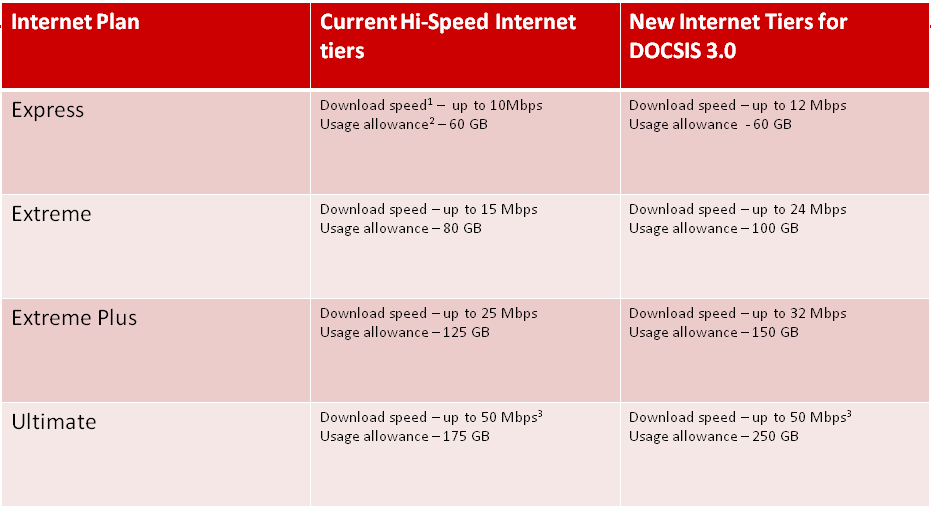
The problem with the Engadget post is that it doesn’t actually spell out all of the details; specifically:
- This is not an automatic increase in your download speeds or bandwidth cap – it’s only available if you have a DOCSIS 3.0 cable modem; and,
- While there is no up-front charge for switching to a DOCSIS 3.0 modem, you will pay an additional $1.50 to $3.00 a month for it.
Rogers is quite straightforward about the details in their own announcement, which they posted here – though at the same time, it’s counter-intuitive as to why they’d offer slightly higher caps if you switch to a new modem. Amusingly, if you click the Rogers link above, the table you see reproduced here is actually a very large 1,400KB bitmap file which gets shrunk in your browser to the appropriate size. What you see above in this page is a 34KB PNG file that looks exactly the same, to the pixel. If everyone made images 40 times bigger than they needed to be, then we’d all need to be on the Ultimate program! As a further jab, their link on the page to see what kind of modem you have doesn’t even work!
Of course, I have a few more thoughts on this whole thing…
-
Photographers vs. Non-photographers
I’ve made a decent effort – perhaps to the point of being annoying – to be clear that I consider myself a non-photographer. Initially I used the term “amateur photographer”, but I realized that this wasn’t distinct enough – some “amateur photographers” go on international trips just to shoot pictures and hone their craft. That’s not the image I was trying to conjure up, so I switched to the term non-photographer.
I wrote a brief post some time ago titled “Amateur vs. Enthusiast vs. Pro” (before adopting non-photographer) to better state what I meant by this, but I always intended to revisit the topic and be a little clearer about the differences. I feel especially compelled to do that now, as despite lugging around the professional D3 and even some pro-oriented glass, I’m still definitively a non-photographer. What do I mean when I say this? Perhaps this table will help:
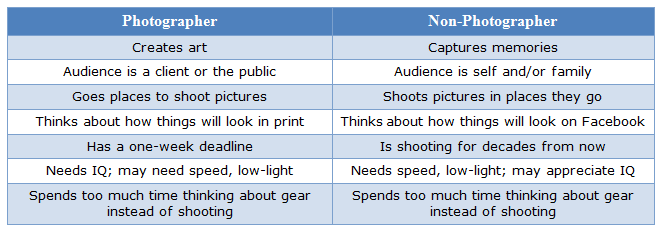
Each row in the table (except perhaps the last) requires a little elaboration, which is below…
-
Frequent traveller programs – worthwhile?
I travel – a lot. Not as much as many salespeople, but enough that I’m sure I laughed harder than most at several parts of the movie “Up In The Air“, starring George Clooney – in particular at the parts poking fun at the rituals of checking in, clearing security, and so forth (the movie is worth watching, if you haven’t seen it). While I’m not even a tenth of the way to the 10 million mile threshold that is a theme in that movie, I’ve done about 20 trips and 100,000 miles of traveling per year for five years running now – about 80% business, and 20% personal.
“Up In The Air” lampoons the obsession of some of its characters with loyalty programs; the amusing thing is that there are many with real-life levels of obsession not far off from what the movie depicts. Indeed, recent studies of social gaming (Farmville, etc) show that whenever you succeed in creating a sense of accomplishment that’s visible/measurable, people can wind up in a near-addictive state in pursuing achievements that are often meaningless. Like the goal I mentioned of reaching 1v1 Diamond in Starcraft 2, though at least that’s based on some kind of skill development…
But how useful are these loyalty programs, anyways? A recent experience prompted me to write this post to share some thoughts on the topic…

-
If only mom could see his face…
I often refer to myself as a non-photographer, primarily concerned with capturing memories before they evaporate from my decreasingly reliable grey matter. Those in front of the lens, on the other hand, might actually learn that reality was a little different than they remember – for instance, that Leo wasn’t just happily eating his breakfast:

The other thing I find funny about this picture is that as usual, Valerie is using her powers of psychokinesis on the kids – opening her own mouth in order to get them to open theirs, even if they’re not looking at her. Sadly, Olivia is pretty much immune to this mind trick, and to all other forms of peer pressure. Looks like Leo was fooled, though, much to his ultimate displeasure!
-
Thoughts on the Nikon D3
A while ago, before Herman finally settled on a D7000, I wrote a post on the D7000 vs. D90 since I used the latter for quite some time before upgrading to the former, providing a few reasons why I thought the choice for many would come down to those two (though the D5100 wasn’t available then). I also mentioned, in talking about lens selection, that full frame just doesn’t make sense for most people, and thus not to buy lenses with the assumption of going to full frame.
Of course, all that was before buying that big batch of equipment, which temporarily put a full-frame D3 in my possession – which I’m still using for the moment. This has actually turned out to be pretty handy, because I’ve had to send my D7000 back to Nikon again due to oil spots appearing on the sensor; this is an issue that some D7000 users have encountered, and while Nikon cleaned it up the first time I sent it back, the problem has recurred. Since it can take Nikon a while to service anything (customer service is definitely not their strong suit), it’s pretty fortunate to have two bodies!
So, what’s the experience been like with the D3? In short, despite that it’s closing in on being 4 years old (which is about 80 in camera-years), it’s still a fantastic camera. It’s not all good, but here’s what I noticed most:
- What I said before about it being too big, too heavy, and too expensive is still all true. Even used, a D3 in good condition with a low shutter count is more than $3,000, and it’s monstrously large. The price tag is even higher for either of its updated siblings, the D3s and D3x. The weight is still something I can manage; it’s much lighter than either of my two kids!
- Performance wise, its 12MP full-frame sensor (same as in the D700) is still great; even after all this time, modern crop sensors like in my D7000 still can’t match it at ISO 3200 or 6400. The D3 sensor also seems to preserve highlights better. It’s just amazing that this sensor was introduced so long ago and still beats any crop sensor. If this was any other type of silicon (e.g. a CPU or GPU), it wouldn’t even be close.
- A pro lugging a bag won’t care about this, but the fact that there’s no built-in flash is somewhat inconvenient; and if you want to do off-camera flash, you need at least an SB-800 to act as a commander. I’d definitely favor the D700 even if you just want the improved sensor.
- I still like the full-frame look; I don’t know whether it’s the shallow depth of field or just the color rendition, but it seems to have the edge over the sensors in either the D90 or D7000, even when low light is not an issue.
- While my most used lens – the 24-70/2.8 – is useful for me on both full-frame and crop sensors, I like it better on the full-frame D3 than on the crop sensor D7000.
- Autofocus; see below.
Autofocus Performance
What’s actually better about the D3 than anything else I’ve ever used? Quite simply, the speed of its auto-focus (while still maintaining accuracy, I suppose):

If you click to zoom in, you’ll see that while it’s not perfectly pixel-sharp – this is an object clearly in motion, after all – the focus is really where it should be (you can see based on the non-moving grass). Usually I have to take 10 shots like the above hoping for one sharp one, or try and pre-focus and hope for the best, but the D3 really nailed things on almost every shot.
Even more remarkable, it’s not that it just locks on for the first shot, it’s able to keep things in focus even in continuous burst mode:

This is the same jump as the first picture; all I did was just hold the shutter down. I’m sure I’ll be missing this kind of speed once I switch back to the D7000 on a more permanent basis, but at least it suggests there’s still things to be improved on the consumer bodies.
Now I can understand why dedicated sports shooters might pony up the big bucks for a D3-class body; it’s not enough for me that the D3 makes sense as a primary camera, but at least I know that at least some D3 owners are definitely getting what they paid for.
Firmware Updates
Ironically, I’ve used these bigger cameras when the cameras I’ve actually owned for the long term have been in for repair. I got the D700 when sending my D90 back into Nikon (it was completely dead till they replaced a circuit board), and now I’m using the D3 exclusively while the D7000 gets cleaned again.
And just yesterday, I ran into “dead battery syndrome” with D3, in which with a perfectly good battery the camera just displays a battery warning indication and refuses to function. This post was almost a gripe about how Nikon DSLRs make great images, but seem to be lacking in reliability or quality control.
Fortunately, this D3 battery problem was corrected with new user-installable firmware (I had 1.00, 2.00 fixes the problem, and 2.02 is the latest for the D3). But I’m writing this because I ran into some real quirks installing the firmware. The D3 has two firmware files, an ‘A’ file and a ‘B’ file. The ‘A’ file installed per Nikon’s instructions; copy it to the root of a CompactFlash card, put the card in the camera, then select firmware update in the menu – simple!
The ‘B’ file didn’t work this way for me, though. The camera saw the file, gave the option of doing an update, said it was upgrading… and then dropped back to menus. No error message, no information, and no change to the ‘B’ firmware! I tried reformatting the card in the camera, reformatting it in the computer, changing batteries, changing cards – nothing worked.
Finally, I decided to try formatting the memory card in-camera and then transferring the file over USB (with the D3 connected to my PC via USB), in case something about how the file was being written by Windows 7 using my card reader was incompatible. Bingo! This actually worked, and got the ‘B’ firmware installed.
This is all pretty boring, but since I found nothing on this in my own Google searches, I’m hopeful that someone else encountering this issue might be fortunate enough to stumble upon this thanks to the magic of Internet search!
-
Is it always better to get better?
We go through nearly our entire lives trying to be better at doing something. From early childhood, our parents strive to ensure that we achieve our maximum potential, whether that’s getting better grades, making a sports team, learning to play an instrument, or some other endeavor. Of course, that’s just the beginning; after we finish with the degrees and diplomas, which ostensibly demonstrate progress in something, we then move on to what’s often a 40 year slog to improve our careers, and our financial standing. Even once we’re well into this, if we have a little free time, we might still take up a new language, or head down to Home Depot in order to change than vinyl flooring into ceramic tile. It’s ingrained in us that we need to do better, be all we can be, aim higher, etc.
But when does this actually make sense? In our jobs, certainly – you can either spend 40 years doing the same thing over and over, or you can constantly strive to improve and learn giving yourself much better odds on finding diverse, interesting, and challenging work. Further, in our capitalist society, work is the one place where we truly do compete for survival – the comforting nature of a bi-weekly salary often hides the fact that sometimes even with a single contract, one company will win and secure its future, while others will lose and may need to fire some or all of their staff as a result. I think early education is clearly another; while the value of advanced degrees is under fire these days, it takes a decent amount of achievement to reach a level where you’re a candidate for a job that you won’t hate for the rest of your life, and that can at least put food on the table.
-
WordPress is great… with a little help
 WordPress is the software for blog sites that I chose to use for this blog (which is pretty obvious, since I haven’t even changed some of the default links that are supplied). Since I tend to comment on games, cameras, lenses, or services that I like – or don’t – it’s probably about time that I commented on WordPress.
In a word, for free software, I personally think that it’s outstanding. While most people probably use WordPress by way of wordpress.com, which will happily host your blog for you, I went with the slightly higher effort approach of getting a hosting provider (InMotion), and installing the free and open source WordPress software onto the virtual server that they provide. I figure I’d learn more this way, and also have more flexibility – and both those things are indeed true.
For something that’s free, WordPress sets the bar very high. Installation was a breeze, updates are automatic and seamless, and usability is great; you can pretty much just install it and start plugging away. Even better, while the hosted version of WordPress lets you choose from various themes, running it yourself also offers a wide variety of plug-ins that customize the behavior of things in various ways. There’s three that I find very useful, all free, including the one I started using recently to avoid my longer posts from destroying your RSS reader…